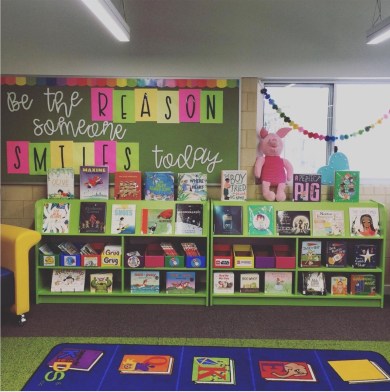
 Note. Library love! [Photograph], by itsalibrarianlife, 2021, November 18, Instagram. (https://www.instagram.com/p/CWaYHn3vav6/)
While researching the school library community, one problem I repeatedly came across was the lack of studies and peer reviewed articles that were based in the United States. There are a lot of studies and articles coming out of Australia and Canada, but none out of our own country. It really has made me think about the reasoning behind it. Are school libraries less valued in the U.S.? Could other countries be doing things better? Do we not have an academic researcher who has the passion to pursue studies in this field? I would love to be able to read articles focused in the U.S. that are similar to some of the research I found around the world.
Within the information I collected, there was a recurrent pattern of thought of the school library as a “safe-haven” and a place of “well-being.” Many students come to the school library when they are social outliers and want a “port in the storm” and they can find this within the school library community. The school library is a quiet place where they can be themselves, have fun, get rejuvenated for the day, and get away from the hectic world schools can be (Joing, 2023; Knapp, 2022; Merga, 2021). More can be read on the subject in these articles:
“The School Library: An Important Place for Adolescents’ Well-Being. An Ethnographic Experience in a French Middle School” By Isabelle Joing


“Creating Safe and Inclusive Spacing for LGBT2Q+ Youth in Public and School Libraries” By Christopher Knapp


“Libraries as Wellbeing Supportive Spaces in Contemporary Schools” By Margaret K. Merga
In the article entitled, “Making Spaces for STEM in the School Library” by Stacey Woods and Yu-Chang Hsu, I learned about the importance of STEM/STEAM in our education system and for many career paths (2019).
STEM = Science, Technology, Engineering, and Mathematics

STEAM=Science, Technology, Engineering, Arts, and Mathematics
The overall education system in the United States has a push to implement these into schools. There are still many schools that do not offer learning in this focus. The article touches on the importance for the school library and its makerspaces to fill the gap for those schools that currently do not have STEM/STEAM offerings. This can be in the form of clubs, after school activities, or by the school librarian collaborating with math or science teachers. Woods and Hsu suggest creating activities and an area within the makerspace that have supplies to perform STEM/STEAM activities—even if it means their makerspace is on a book cart that can be moved from place to place (Woods & Hsu, 2019, p. 392).
Makerspace Definition
“Makerspaces are loosely defined as any space where students (or adults) can make things, a place for hands-on learning where ideas and tools are shared. In schools and libraries, that space may be a designated area, a room, a table, or even a portable cart” (Hartman, 2022).
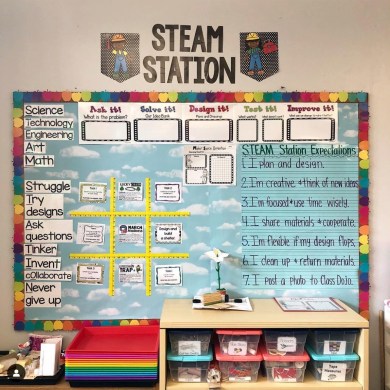 Note. One of my favorite spots in my classroom is the STEAM STATION. . . [Photograph], by christofs_class, 2019, April 24, Instagram. (https://www.instagram.com/p/BwqSWn8h7mW/)
Students are not the only people that make up the school library community. The school librarian is a vital part of make the school library as a safe and welcoming place, along with developing any activities, and being a constant for students. The school librarian has a challenging job, but for those who persevere, the position is greatly rewarding. In the article entitled, “Reflections on Managing a School Library” by Martha J. Spear, we get an in-depth sampling of what it takes to be a school librarian. With Spear’s 30+ years of experience working in school libraries, we get a glimpse into the school librarian’s perspective and what Spear thinks the current training of school librarians lacks (2018). Even though Spear at times sounds pessimistic and negative about the role, it is very realistic. Here she describes the overall job description of a school librarian:
“The school librarian is a manager — despite what others and they themselves might believe…There are common issues of self-sufficiency, conflicting roles, problematic patrons, and lack of respect. School library managers face unique challenges as well. They often have unusually constricted budgets, dubious personnel support, little time to plan, and facilities that are routinely co-opted for other purposes. They are expected to be technology experts and teach on a regular basis. They act as ‘loco parentis’ for their patrons. They must not just promote their services but advocate for their existence” (Spear, 2018, p. 503-504).
Part of how the modern school library has become a welcoming and safe place is through the physical space, layout, and furnishings it has. Many school libraries are being redesigned to promote this. In the article, “Designing Future-Ready School Libraries: Empowering Stakeholders for Evidence-Based Change” by Chin Ee Loh it discusses a study focusing on the redesign of school libraries in Singapore. As part of this three-part study, students were brought in to give feedback and ideas for these redesigns. Loh emphasizes the importance of including students in the design and development in the school library so that it can be a place that young people want to visit (2023).
My community is already a library and information center, but it is important for school libraries to build partnerships with local public libraries. This will give students who might not know about the public library, the opportunity to be exposed to it. Public libraries differ greatly from school libraries. Public libraries often have more resources and flexibility then the school library and librarian, but the school library has extensive access to the students. Some ideas of partnerships are—programming partnered events and classes, library card campaigns, school visits to public libraries/public library visits to school, community reading programs, tutoring, creating curriculum together, and much more (School/Public Library Cooperative Programs, 2017; School-public library partnerships, 2018)!
References
Hartman, E. A. (2022, September 12). Makerspaces: What’s Old is New Again. School Library Journal. Retrieved November 8, 2023, from https://www.slj.com/story/makerspaces-whats-old-is-new-again_220912
Joing, I. (2023). The school library: An important place for adolescents’ well-being. Journal of Library Administration, 63(6), 777–796. https://doi.org/10.1080/01930826.2023.2240192
Knapp, C. (2022). Creating safe and inclusive spacing for LGBT2Q+ youth in public and school libraries. Journal of Library Administration, 62(6), 847–855. https://doi.org/10.1080/01930826.2022.2102385
Library love! (2021, November 18). Itsalibrarianlife on Instagram. Retrieved November 8, 2023, from https://www.instagram.com/p/CWaYHn3vav6/
Loh, C. E. (2023). Designing future-ready school libraries: Empowering stakeholders for evidence-based change. Journal of the Australian Library and Information Association, 72(3), 294–305. https://doi.org/10.1080/24750158.2023.2231229
Merga, M. K. (2021). Libraries as Wellbeing Supportive Spaces in Contemporary Schools. Journal of Library Administration, 61(6), 659-675. https://doi.org/10.1080/01930826.2021.1947056
One of my favorite spots in my classroom is the STEAM STATION. . . (2019, April 24). christofs_class on Instagram. Retrieved November 8, 2023, from https://www.instagram.com/p/BwqSWn8h7mW/
School/public library cooperative programs. (2017, September 12). American Library Association. Retrieved November 8, 2023, from https://www.ala.org/alsc/aboutalsc/external-relationships/schoolplcoop
School-public library partnerships. (2018, February 2). American Library Association. Retrieved November 8, 2023, from https://www.ala.org/alsc/publications-resources/professional-tools/school-public-library-partnerships
Spear, M. J. (2018). Reflections on managing a school library. Journal of Library Administration, 58(5), 503–518. https://doi.org/10.1080/01930826.2018.1468672
Woods, S., & Hsu, Y. (2019). Making spaces for STEM in the school library. TechTrends, 64(3), 388–394. https://doi.org/10.1007/s11528-019-00460-9
 Laurel Everitt
One response to “INFO200 Blog Post #5: School Library Literature & Resources”
I absolutely adored my work as a middle school librarian. Programming was one of the most fun parts! My library was a central hub of the school and was almost never quiet but was often bustling with activity. Students loved even the simplest little crafts and activities I would prepare for them and they enjoyed the opportunity for more elaborate projects using our makerspace tools and other technology. We did find that flexible and comfortable seating options made a huge difference for our library space and usage (the kids loved when we got giant beanbags!), but honestly what you write about school libraries being a “safe haven” and “port in the storm” really rings true. My students often came to the library just to get away from whatever else was going on in their day, and they knew they would be welcomed, often with snacks and a listening ear or an offer for a nap/quiet respite on said beanbags. 🙂 I am super passionate about all libraries, but especially school libraries, being that safe place to welcome those who might feel marginalized elsewhere.
Thank you for your important research into this community!
LikeLike