There are many Information Science models or theories that could represent my Information Community, but here are a couple that I felt strongly represented this community.
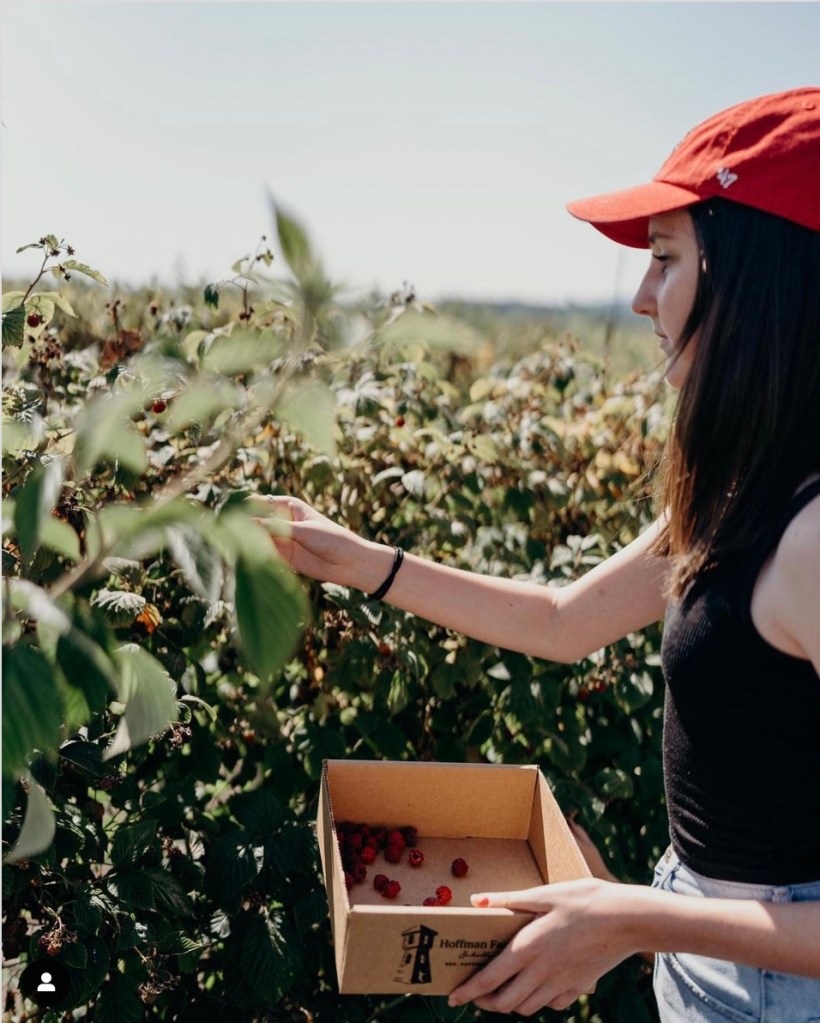
Note. Raspberries have arrived at Hoffman Farms Store [Photograph], by hoffmanfarmsstore, 2023, June 15, Instagram. (https://www.instagram.com/p/CtmsEBdSZBb/)
Marcia Bates originally developed the Berrypicking Model in 1989 and it has since been an inspiration for much of the Library and Information Science world. The basis for this model is the idea that you are metaphorically “picking” (searching, browsing, etc.) “berries” (information) all over a forest or field (sources of information). Going on a meandering path gathering all different types of “berries” to get the whole picture of your information needs (your basket full of all kinds of berries.) Meaning that you take a winding path of twists and turns to gather all the data to complete your information search. Bates created this model when she realized this idea was describing the natural way people search for information. (See this YouTube video by Jenna Hartel for more info on this model!)
The Berrypicking Model is made up of six techniques for searching, which include the following:
1. “Footnote chasing” which is the approach of using the footnotes in a source related to your query to take you on a path through other sources and information related to that item. This is referred to as “backwards chaining” (Bates, 1989, p201).
2. “Citation searching” is using who wrote a citation to find other works or information. Bates refers to this as, “forward chaining” (1989, p201).
3. “Journal run” is using a journal you have found related to your topic and looking through other volumes of this journal for different information.
4. “Area scanning” is basically browsing. It is looking through a specific section of interest. This gives you a broad way to find new authors, topics, sources, etc.
5. “Subject searching” is using indexes, databases, and the like to search through subjects to information seek.
6. “Author searching” which is using a specific author and looking at their other works that include similar topics of information as your inquiry.
These six techniques can all be used together, or the information seeker can “pick” and choose through which methods best work for them. This model says there is not one simple path to find the information you need.
The community that I am researching for INFO 200: Information Communities, is the School Library Community. School libraries are still a traditional source of information for students researching and those checking out books for recreation use, but they are now also “safe havens for social outliers” (Everitt, 2023), places to learn and use new technology, and somewhere to gather. The way this community uses Marcia Bates’s Berrypicking Model is more of a broad sense of the model, in the way the students come to the library to learn, feel safe, and maybe meet others. They go through a natural path of finding “information” and peers that can help them succeed in their goal.
For example, if a student comes to the library because they are LGBT2Q+, but they do not know what that means and they are a social outlier, they might use the school library. They may need to learn about what it is to be LGBT2Q+, and do not have access to internet at home or their parents do not allow them to explore this world. They can use the library to search for information using different techniques such as “area scanning,” by browsing the section on LGBT2Q+ books and resources. This could lead to finding information or perhaps meeting another person also trying to learn about themselves. They then learn from each other and build a comradery. They will then introduce others in the same boat to each other—learning and building a larger network of people and information organically. In this “berrypicking” path that the school library community develops naturally, a community can learn and grow. It is not done in one straight line, but in a path of twists and turns, ups and downs.
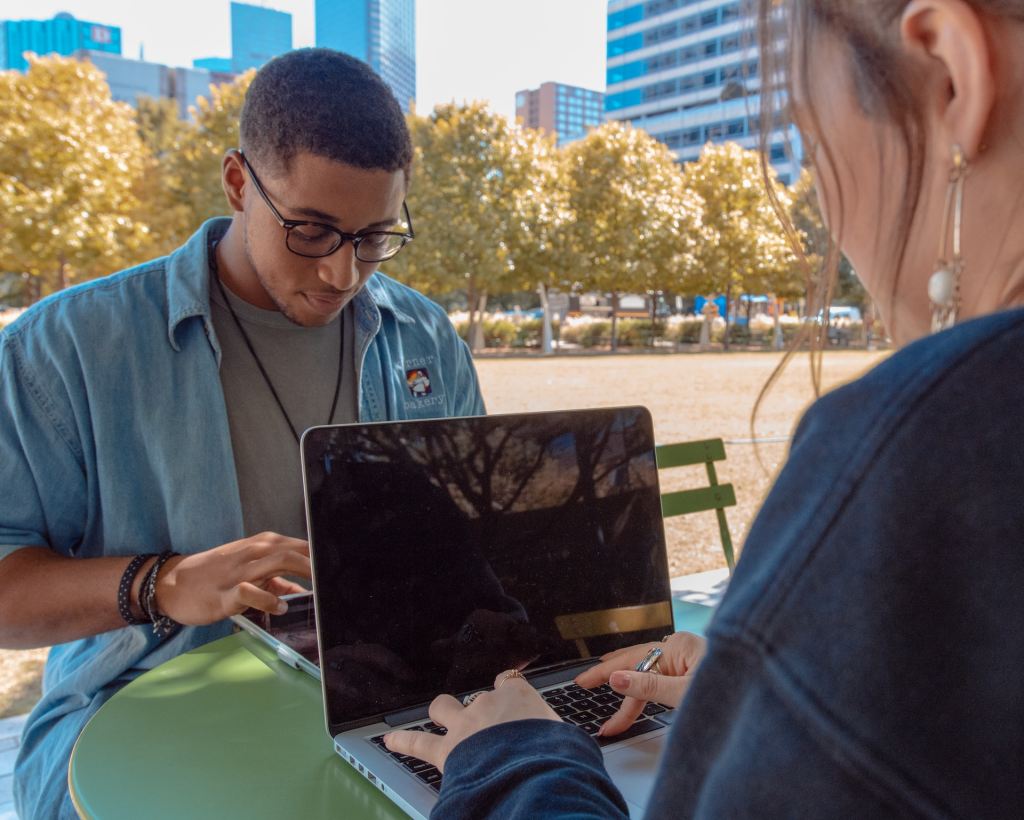
Note. Study dates in the park are the best [Photograph], by Eliott Reyna, 2019, October 23, Unsplash. (https://unsplash.com/photos/iO2d-KYp5JU).
Another information seeking theory that reflects the School Library Community is Reijo Savolainen’s “Everyday Life Information Seeking Theory (ELIS).” ELIS “concentrates on nonwork information seeking… ELIS studies discuss the ways in which people use various information sources to meet information needs in areas such as health, consumption, and leisure” (Savolainen, 2018, p1506). Savolainen talks about centering around “way of life” and “mastery of life” for the average person (1995, p261, 264). It is also comprised of four personal orientations to problem solving:
1. Optimistic-cognitive mastery of life “is characterized by a strong reliance on positive outcomes for problem solving” (Savolainen, 1995, p265).
2. Pessimistic-cognitive mastery of life “the possibility that the problem might not be solved optimally is accepted” (Savolainen, 1995, p265).
3. Defensive-affective mastery of life “is grounded on optimistic views concerning the solvability of the problem; in problem solving and information seeking affective factors dominate” (Savolainen, 1995, p265).
4. Pessimistic-affective mastery of life “can be crystallized in the expression of ‘learned helplessness.’ One does not rely on his or her abilities to solve everyday life problems, but adopts a strategy of avoiding systematic efforts to improve his or her situation” (Savolainen, 1995, p265).
This model represents the process that people go through in their everyday life to find information to help them. For example, a mom is worried about the lack of talking of her two-year-old son. She then looks on the internet to research “what is normal for communication for a child of this age?” She may then decide she needs to get more help and makes an appointment with her pediatrician, who refers her to a Speech Language Pathologist. She calls a list of practitioners to see how they can help her son. (See this YouTube video by Jenna Hartel for more info on this theory!)
ELIS represents many parts of what makes the School Library a community. Students, teachers, and school staff come to the library for other reasons then academic research. They may come to the library to access information on a personal level through the internet. Or they may come to the library to learn about knitting with a knitting club group, because they want to knit themselves a scarf for the winter. The School Librarian may lead a student to sources on free you mental health. These are just a few examples of “everyday life information seeking” brings community together at the School Library, there are so many more.
References
Bates, M. J. (1989). The design of browsing and berrypicking techniques for the online searchinterface. On-line Review, 13(5), 407–424. https://doi.org/10.1108/eb024320
Everitt, L. (2023, September 7). INFO200 Blog Post #2: School Library Community – Life of Laurel. https://ischoolblogs.sjsu.edu/info/laurele/2023/09/07/info200-blog-post-2-school-library-community/
INFIDEOS. (2022b, July 13). Everyday Life Information Seeking. . .by Reijo Savolainen | What makes this paper great? (#9) [Video]. YouTube. https://www.youtube.com/watch?v=yOHYw7ZJ10U
INFIDEOS. (2022, January 6). The design of browsing and berrypicking. . .by Marcia Bates | What makes this paper great? (#8) [Video]. YouTube. https://www.youtube.com/watch?v=Ep5FRCzpY34
Raspberries have arrived at Hoffman Farms Store (2023, June 17). hoffmanfarmsstore on Instagram. Retrieved September 20, 2023, from https://www.instagram.com/p/CtmsEBdSZBb/
Reyna, E. (2019, October 23). Photo by eliottreyna on unsplash. Study dates in the park are the best. https://unsplash.com/photos/iO2d-KYp5JU
Savolainen, R. (2018). Everyday Life Information Seeking. In McDonald, J.D., & Levine-Clark, M. (Eds.), Encyclopedia of Library and Information Sciences (4th ed. pp. 1506-1515). CRC Press. https://doi.org/10.1081/E-ELIS4
Savolainen, R. (1995). Everyday life information seeking: Approaching information seeking in the context of “way of life.” Library & Information Science Research, 17(3), 259–294. https://doi.org/10.1016/0740-8188(95)90048-9


One response to “INFO200 Blog Post #3: Information Models/Theories & The School Library”
Hi Laurel!
I agree with you about the multiple theories that are in use with your school library community. I work in an elementary school library and agree that every day I see theories in action – especially Bates’ Berrypicking model. The majority of the students at my school rarely visit a public library – their only interaction with a library is during school. Their behaviors match several of Bates’ berrypicking techniques such as area scanning, subject searching, and author searching. The students love dinosaurs so I find myself pointing them to the dinosaur section of our library and I explain to them to scan the dinosaur section of the shelf because that is where they will find similar books – not only about types of dinosaurs, but fossils, and all-things-dinosaur – as well! So, I, too, am teacing students how to area scan!
I thought your post was very informative!
LikeLike