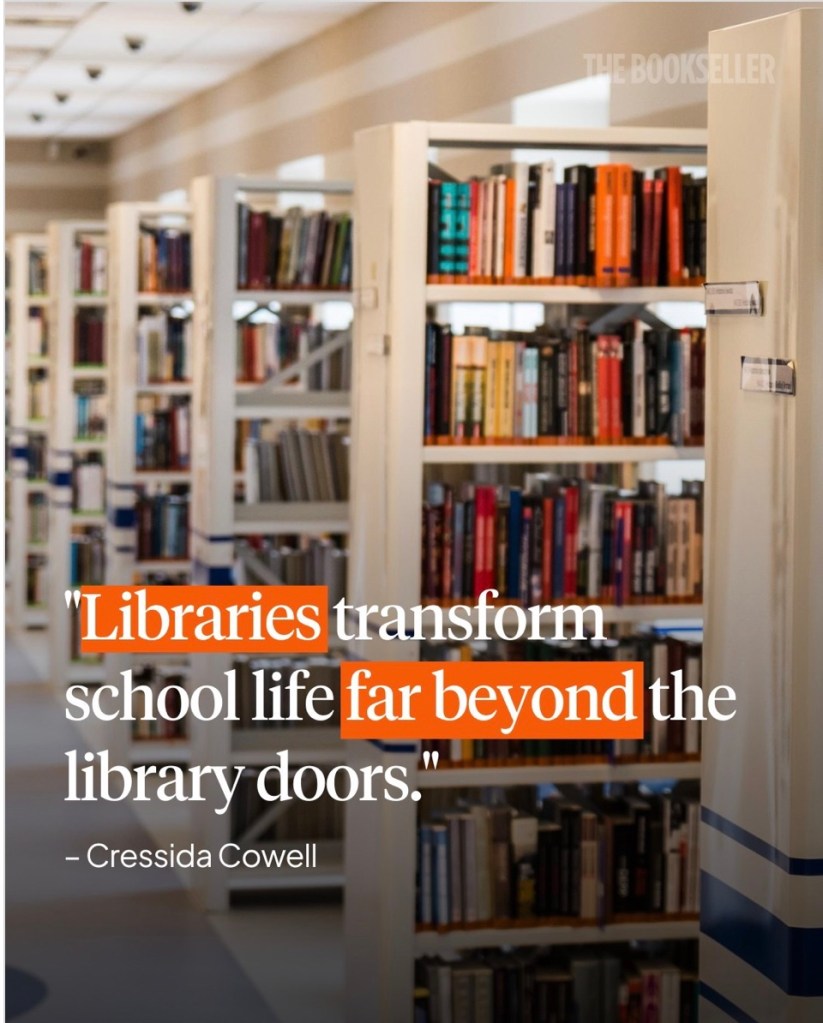
Note. Libraries transform school life far beyond the library doors [Photograph], by _thebookseller, 2022, November 15, Instagram. (https://www.instagram.com/p/Ck_Efyhsq5E/)
Remember this…
You’re in second grade and it’s Thursday morning, your teacher is calling students by name to line up at the door. You’re wiggling in your seat, waiting for her to call your name. You can hardly contain yourself because it’s library day! Oh! The excitement of listening to school librarian read your class a story and then being able to go pick out a book (all by yourself!) to take home.
Later on …
You’re an awkward teenager in high school, you are trying to figure out your identity, you don’t have a lot of friends, so you feel most comfortable finding a quiet spot in the school library to read a book and spend time away from surroundings and people that make you feel uncomfortable.
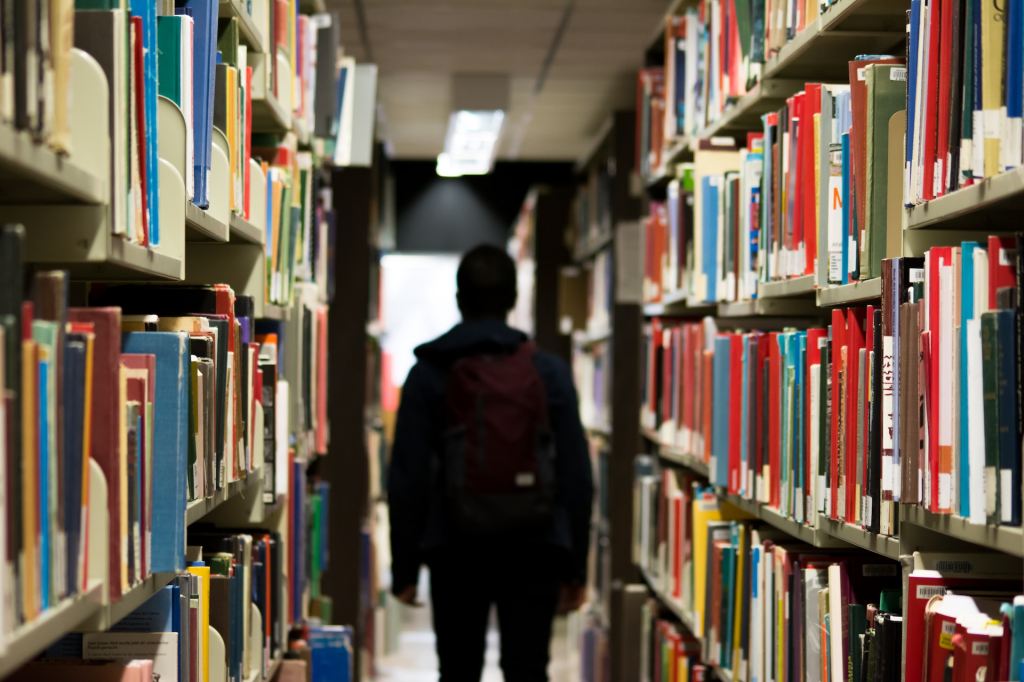
Note. Man with backpack beside a books photo [Photograph], by Redd F, 2015, March 28, Unsplash. (https://unsplash.com/photos/9o8YdYGTT64).
“School libraries (or media centers) provide fundamental services to primary and secondary schools (K–12). Their function is to serve the learning needs of the school community by providing resources and instruction…. The program is both the physical and virtual learning center filled with resources and tools that support inquiry and exploration and the services provided by information professionals” (Harlan, 2022, p. 91).
In Information Services Today: An Introduction, Harlan defines the basic structure of what a school library is and does, but in this definition, she does not touch on how school libraries go beyond that definition.
“School libraries can be highly valued safe spaces for avid users… and they may be valued for their capacity to foster belonging and sanctuary, allow exposure to books and opportunities for reading, and provide a space for relaxing and recharging” (Merga, 2021)
Libraries have also turned into safe havens for social outliers to find sanctuary in the walls of the school library. They are places for students who feel disenfranchised from the rest of their peers to shelter. It is a place for students of a like mind to find common ground.
“Libraries have traditionally existed as spaces that serve as the ideal grounds for creating a space of safety and inclusion for LGBT2Q+youth, and for all those who exist on the margins of society” (Knapp, 2022).
The school library is a place for programs and events to take place. Where students and faculty can gather to have access to new and advanced technology that might not be available in their everyday lives. This can be anything from 3D printing to programming robots, to in the future – for example, working with Artificial Intelligence (AI). It can act as a bridge to the public library. A place to offer volunteer opportunities to parents and students. Now, sometimes being referred to as a “makerspaces” (Woolls, 2018, p. 4003).
“Through instruction, mentoring, and coaching, school librarians encourage inquiry and knowledge building and create flexible spaces (online and at school) for collaborative learning, personal pursuits, and sharing of knowledge” (Harlan, 2022, p. 92).
You can’t bring up school libraries without mentioning that they have always had controversies surrounding them—and still do. For example, some of the most recent events surrounding banned books in Florida, school library closures and conversion to detention rooms in Texas, and the removal of the bible out of school libraries in Utah.

Note. All are welcome here [Photograph], by kindredbooks, 2023, September 1, Instagram. (https://www.instagram.com/p/CwqrhRtry7l/)
The School Library as a Community…
How does the School Library fit into the definition of a “community?” In the text, Information Services Today: An Introduction, Fisher & Fulton talk about the four types of community—Affinity, Instrumental, Primordial, and Proximate. (2022, p. 42).
The school library fits most obviously in Proximate because everyone is there based on the school—which they either attend, work at, or have children attending. Since the school library is also a gathering place for specialized activities and interests, meetings, acceptance, and interest in books, it fits with Affinity.
As mentioned previously, the school library acts as a safe-haven for the LGBT2Q+ youth of the school, so you could also say it fits in with Instrumental because this group is constantly fighting to be accepted and heard. This group can also fit with Primordial because LGBT2Q+ isn’t just a group with a similar interest, they are a group fighting to be able to live their true selves—finding a true identity. The school library gives these students the ability to research, learn, and have access to information about themselves that they might not necessarily have at home.
Fisher and Fulton also mention Durance’s definition of information communities and the five characteristics that make up these communities:
“Emphasis on collaboration among diverse information providers.” The whole point of the school library is to build on collaboration. The school librarian works with the teachers to create programming and students come seeking help with research for school projects. You can also add that the school library collaborates with the local public library to offer more opportunities for the school library community to be able to access information and others outside the school life.
“Capacity to form around people’s needs to access and use information.” Be it a class project, or an LGBT2Q+ youth wanting research to discover who they are, the school library community provides these opportunities.
“Capacity to exploit the information-sharing qualities of emerging technologies.” The school library is usually the place where the new technology that a school has acquired is housed and available to students.
“Ability to transcend barriers to information sharing.” At some homes students might not have access to internet or a computer, or their parents may closely monitor their access. The school library gives students the opportunity and freedom to research topics of interest.
“Capacity to foster social connectedness.” For those students who don’t feel as if they fit in with the “regular” crowd, the library community brings together students that might not have necessarily met in a large school environment. Others that have similar feelings of being on the fringes and having interests out of the “norm” find friendship and community at the school library (2022, p.43; Durance, 2017).
School libraries are still very much the same as in the past, but they are also so much more now. They are a community for students, teachers, and parents alike. A place of discovery, finding comradery, and a safe place to just “be.” They are run by a school librarian, but they are also a place for teachers to collaborate with the librarian and for students to learn from someone else in their school community that differs from their regular teacher or teachers. They are places of self-discovery and a shelter from the storm. School libraries are a multifaceted community offering opportunities to learn, explore, and feel safe—they are the school library community.
References
All are welcome here (2023, September 1). kinderedbooks on Instagram. Retrieved September 7, 2023, from https://www.instagram.com/p/Ck_Efyhsq5E/
Bauld, A. (2023, August 31). Librarians can play a key role implementing artificial intelligence in schools. School Library Journal. https://www.schoollibraryjournal.com/story/Librarians-Can-Play-a-Key-Role-Implementing-Artificial-Intelligence-in-Schools
Durrance, J. C. (2017). The vital role of librarians in creating information communities: strategies for success. Library Administration and Management, 15(3).
F, R. (2015, March 28). Photo by Redd F on unsplash. Man with backpack beside a books photo – Free School Image on Unsplash. https://unsplash.com/photos/9o8YdYGTT64
Fisher, K. E., & Fulton, C. (2022). Information communities. In S. Hirsh (Ed.), Information services today: An introduction (3rd ed., pp. 41–52). Rowman & Littlefield Publishers, Incorporated.
Goodman, J. D. (2023, August 25). Texas revamps Houston schools, closing libraries and angering parents. The New York Times. https://www.nytimes.com/2023/08/13/us/texas-houston-schools-libraries-takeover.html
Harlan, M. A. (2022). Literacy and media centers: School libraries. In S. Hirsh (Ed.), Information services today: An introduction (3rd ed., pp. 91–101). Rowman & Littlefield Publishers, Incorporated.
Knapp, C. (2022). Creating safe and inclusive spacing for LGBT2Q+ youth in public and school libraries. Journal of Library Administration, 62(6), 847–855. https://doi.org/10.1080/01930826.2022.2102385
Libraries transform school life far beyond the library doors (2022, November 15). _thebookseller on Instagram. Retrieved September 7, 2023, from https://www.instagram.com/p/Ck_Efyhsq5E/
Luscombe, R. (2023, June 21). Utah district returns Bible to school libraries after reversal of parent-led ban. The Guardian. https://www.theguardian.com/books/2023/jun/21/utah-bible-school-libraries-ban-reversed
McMillan, D. W., & Chavis, D. M. (1986), Sense of community: A definition and theory, Journal of Community Psychology, 14(1). https://doi.org/10.1002/1520-6629(198601)14:1<6::AID-JCOP2290140103>3.0.CO;2-I
Merga, M. K. (2021). Libraries as Wellbeing Supportive Spaces in Contemporary Schools. Journal of Library Administration, 61(6), 659–675. https://doi.org/10.1080/01930826.2021.1947056
Wixon, C. (2023, August 29). Moms for Liberty banks on new state law; Indian River School Board to remove 20 books. Treasure Coast Newspapers. https://www.tcpalm.com/story/news/education/indian-river-county-schools/2023/08/29/more-books-to-be-removed-from-school-libraries-in-indian-river-county/70705657007/
Woolls, B. (2018). School Libraries. In McDonald, J.D., & Levine-Clark, M. (Eds.), Encyclopedia of Library and Information Sciences (4th ed. pp. 4000-4007). CRC Press. https://doi.org/10.1081/E-ELIS4
 Laurel Everitt